

The storm had raged across the Western Desert for nearly an hour, lashing sand across the dunes in great, roiling sheets. When it finally passed, Dr. Lena Aouad felt the same relief she always did after a desert storm—like the land itself had offered up some secret. She just hadn’t expected the secret to be literal.
She lifted her scarf, squinting toward the dune line. Something gleamed where nothing should have been.
“Ravi,” she called over her shoulder, “come look at this.”
The astrophysicist trudged up beside her, still brushing sand from his gear. “More pottery shards? Please let it be pottery. I’m sick of pottery.”
“It’s not pottery.”
She pointed.
Halfway down the dune, a block of stone jutted out at a clean angle from the sand—too smooth, too dark, too perfectly shaped to be natural. The storm had stripped the slope clean, revealing what looked like the edge of a doorway.
Within an hour, the team was gathered around it, hands brushing away the last stubborn clumps of sand. The stone was nearly black, polished so well that despite the grit of centuries, it reflected the desert sun like a mirror.
“No markings,” Lena murmured. “No hieroglyphs. Nothing dynastic.”
“It almost looks volcanic,” one of the geologists said. “But there’s no volcanic activity anywhere near this region.”
“Unless someone brought it here,” Ravi muttered.
It was meant as a joke, but the tone of his voice made Lena glance at him.
By dusk, they had uncovered enough to reveal a sealed stone door fitted perfectly into its frame. Nothing had shifted or settled. Whoever built it had intended it to stay shut forever.
And yet, the desert had pried it loose.
The team worked through the night with portable lights burning harsh white halos across the sand. When the door finally eased inward with a dry sigh of ancient air, the entire group stepped back instinctively—as though something might come out.
Nothing did.
Inside, there was only darkness.
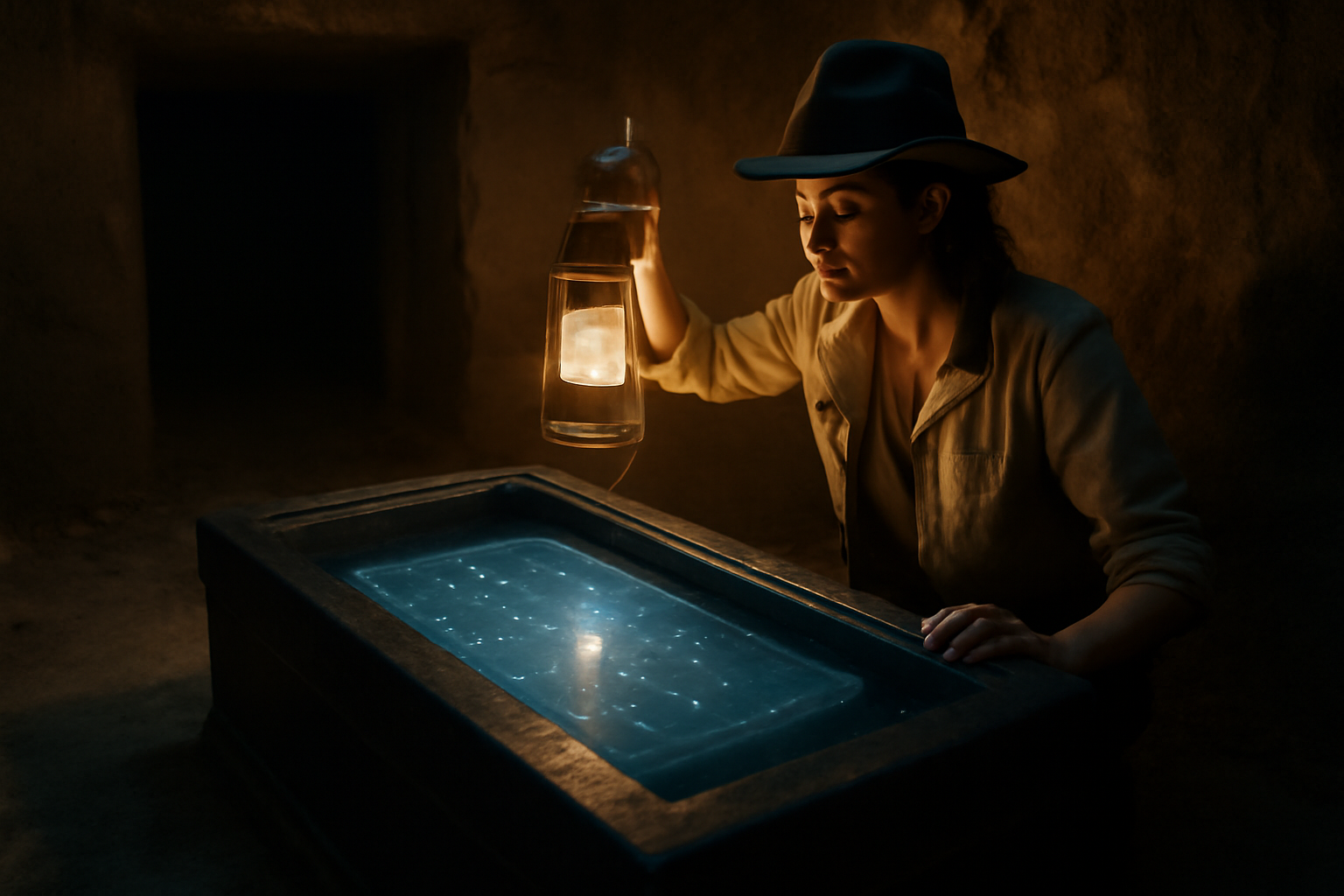
Lena lowered her lantern and descended the shallow steps carved into the rock. The corridor opened into a chamber so meticulously carved that the walls looked poured, not chiseled. No tomb paintings. No protective spells. No signs that a human culture had touched this place at all.
At the center of the room was a single sarcophagus.
It was made from the same obsidian-black stone as the doorway, seamless and perfectly smooth. No symbols. No indication of a body inside.
“Please tell me this is pottery in disguise,” Ravi whispered.
Lena didn’t answer.
The lid was lighter than it looked—almost unnervingly so. When they eased it to the floor, everyone leaned in.
There was no mummy. No bones. No wrappings.
Instead, floating one inch above the bottom of the coffin, was a slab of translucent crystal. It hovered perfectly still, humming faintly.
“What… is holding it up?” one of the grad students breathed.
Lena reached toward it slowly, half expecting a spark or a shock. The slab was cool—too cool. Her fingertips tingled as if touching dry ice.
Then the crystal lit from within.
A star appeared in its center. Then another. Then dozens, hundreds, blooming like scattered firelight. Lines drew themselves between the points—curving, threading, looping in ways that defied the geometry of Earth’s sky.
“It’s a star map,” Ravi whispered. “But nothing fits. The constellations aren’t right.”
“Maybe they’re not our constellations,” Lena murmured.
They carried the slab—still floating—back to the main tent under armed guard, although none of them could say what they expected to guard it from. The instruments they aimed at it overloaded instantly. Cameras distorted. Temperature readings fluctuated. Even the satellite phones picked up a faint, pulsing interference.
For two days, Ravi worked without sleeping, mapping every point of light against known stellar databases. Nothing matched. On the third evening, bleary-eyed and wired on bitter instant coffee, he ran a comparison on a whim.
Small bodies. Not stars. Objects within the solar system.
When the models resolved on his screen, he froze.
“Lena,” he called, voice cracking. “Get in here.”
She hurried inside—and stopped dead.
The map was not a map of stars.
It was a map of the asteroid belt.
The points of light matched hundreds of catalogued asteroids—and hundreds more that no telescope on Earth had ever observed. But the most stunning thing wasn’t the number of rocks.
It was the structure.
The asteroids were arranged with impossible precision, connected by faint lines that became clearer the longer one stared. Rings. Bridges. Hollowed-out forms. It was an architectural grid, stretching across millions of kilometers.
A city.
A city in the void.
“This is engineered,” Ravi whispered. “Nothing in nature forms structures like this. This is intentional. Intelligent.”
Lena felt her pulse in her throat. The knowledge settled over her like cold rain.
“Whoever built this… lived in the belt,” she said. “They weren’t on Earth at all.”
That night, something new happened.
The crystal slab brightened suddenly, filling the tent with cold white light. Lena shielded her eyes, cursing—then froze as the light sharpened and deepened, transforming into a shimmering three-dimensional image suspended above the slab.
A ring-shaped asteroid rotated in front of her, its surface carved with soaring spires and great open caverns. Bridges spanned its interior like webs of glass. Light pulsed along conduits beneath its surface. And in the shadowed avenues between structures…
Shapes moved.
Tall, slender figures glided along illuminated walkways, their forms too graceful, too fluid to be human. They moved with purpose—toward something glowing on the far horizon.
Then one of them stopped.
Turned.
And looked directly at Lena.
The image vanished.
She staggered backward, heart hammering.
“It’s not a recording,” she whispered. “It reacted.”
The power sensors went wild. In the sky above camp, a thin beam shot upward from the tent, visible for only an instant. But every satellite watching the Earth caught it.
Two days later, astronomers worldwide reported something unprecedented: several large asteroids in the belt had shifted positions. Not drifted—shifted. As though nudged into new alignment.
Someone—or something—had heard the signal.
And the city was waking up.
On the fourth night, Lena stood alone outside the tent, staring at the stars. She felt small beneath them, but for the first time in her life, she also felt watched.
Not in fear.
In expectation.
The message was clear.
Humanity wasn’t the first intelligent species in our solar system.
We were just the first to arrive late.
And the ones who came before had left their address behind—buried in a tomb that had never held a body.